
Intraoral Scanner vs Traditional Impressions: Accuracy and Comfort
An intraoral scanner records your teeth in 3D without impression putty. Here is how it compares with traditional impressions on comfort, time and accuracy, and where conventional methods are still preferred.

Doğa Erginoğlu Dental Practice
Last updated:
Every custom-made restoration, whether a crown, a veneer or a night guard, starts with an accurate copy of your teeth. For decades that copy was taken with a tray of soft impression material. Today the same record can be captured digitally with an intraoral scanner, a small optical device that builds a 3D model of your teeth on screen. This article explains how scanning works, how it compares with traditional impressions on comfort, time and accuracy, where its limits are, and what happens to the scan afterwards.
Why impressions are needed
An impression is a copy of your teeth, gums and bite that can be worked on outside your mouth. Crowns, bridges, veneers, inlays and onlays, implant crowns and night guards are all designed and made from it. The more accurate the impression, the more predictable the fit, the margins and the bite of the final restoration.
Impressions are not only for making things. They are also used as records in treatment planning, for example to document your starting point before a smile design, so that later steps can be compared against it.
How an intraoral scanner works
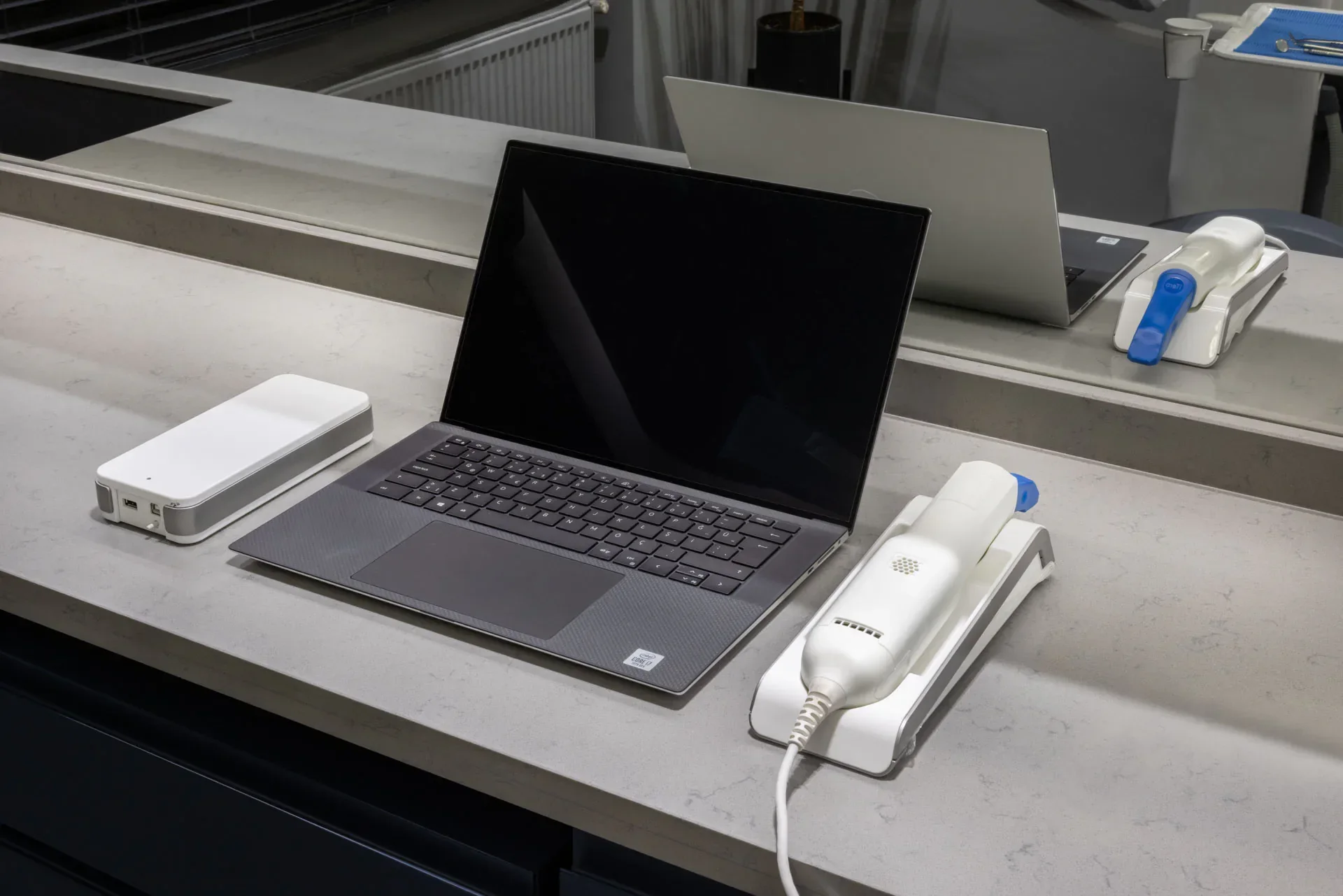
An intraoral scanner is a handheld wand with a small camera in its tip. As the dentist moves it slowly over your teeth, it captures a rapid series of images, and software stitches them together into a three-dimensional model. Usually the upper and lower jaws are scanned separately, then a short scan with your teeth together records how they meet. Because the model appears on screen in real time, any missing areas can be spotted and rescanned straight away. The scanner is an optical device that uses visible light; it does not use X-rays.
What it feels like and how long it takes
Only the tip of the wand is in your mouth. Cleveland Clinic's patient information notes that because a small wand replaces a tray of putty, digital scanning is usually easier for people who gag, and it leaves no residue behind. You do need to keep your mouth open for a while, and short breaks are possible if you need them.
How long it takes depends on how much of the mouth is being scanned and on the conditions inside it. A 2021 systematic review by Siqueira and colleagues found that both quadrant and full-arch scans were faster than conventional impressions.
Conventional vs digital impressions
Comfort and the gag reflex
With a conventional impression, a tray filled with material is pressed over the teeth and held until it sets. Upper impressions in particular can trigger gagging as the material moves towards the palate. Scanning avoids that waiting period altogether. Across the 17 clinical studies in the Siqueira review, patients generally preferred intraoral scanning.
Time
The same review found scanning faster than conventional impressions. When the entire workflow is digital, the time savings can grow. In a randomised trial described in a 2017 systematic review by Joda and colleagues, a complete digital workflow for implant crowns was more than twice as fast as a mixed analogue and digital workflow (about 75 minutes versus 157). The authors also noted that randomised trials were few and that firm recommendations were premature.
Accuracy: what the evidence shows
For most patients, accuracy is the key question. A 2022 rapid umbrella review by Afrashtehfar and colleagues found that most of the 11 reviews it examined rated scanner accuracy as comparable to conventional impressions. Clinical equivalence was shown for short-span fixed work of fewer than 4 units, such as single crowns and short bridges. The Siqueira review likewise found similar prosthetic outcomes with both workflows, and Cleveland Clinic describes the accuracy of digital impressions as comparable to, or better than, putty impressions.
Limits: large bridges and removable dentures
Scanning does not replace conventional impressions in every case. The same umbrella review notes that conventional impressions are still recommended for extensive fixed restorations and for removable dentures. Bleeding, saliva or preparation margins that sit below the gum line can also make scanning harder. The right method depends on the treatment and on the conditions in your mouth.
After the scan: 3D design, milling and printing
The scan is imported into computer-aided design (CAD) software, where the restoration is designed in 3D around the shape of the tooth, the neighbouring teeth and your bite. Thickness, contact points and the fit against the opposing teeth can be checked on screen and adjusted before anything is made. It can then be made in one of two main ways:
- Milling (CAD/CAM): the design is carved from a block of ceramic or composite by a computer-controlled milling unit.
- 3D printing: models, mock-up guides, temporary restorations and night guards can be printed layer by layer.
According to Cleveland Clinic, in some cases a tooth can be scanned, the crown designed on screen and milled from a ceramic block in the practice, so that it is fitted in the same visit. The same source stresses that not every patient or tooth is suitable. In other cases the digital file is sent electronically to a dental laboratory. The digital dentistry page gives an overview of the full workflow.
Where it is used
Intraoral scanning can be used in many treatments, including:
- Single crowns and short bridges (crowns and bridges)
- Porcelain veneers
- Ceramic inlays and onlays (inlays and onlays)
- Implant crowns (dental implants)
- Records and mock-up preparation in digital smile design
- Night guards and some other protective appliances
Whether a digital impression suits your treatment is decided at the examination, based on the extent of the restoration and the conditions in your mouth.
Digital records: follow-up and sharing with your home dentist
Unlike physical models, scan files do not wear or break, and they can be stored. That makes it easier to compare later scans with earlier ones, for example when monitoring wear or changes in gum level over time.
For patients who travel for treatment, digital records have a practical advantage: they can be shared with your dentist at home, who can then take over routine follow-up. When records are exchanged, it helps to know how teeth are numbered. Most countries use the two-digit FDI system, while dentists in the United States usually number teeth from 1 to 32, so the tooth a US dentist calls #3 (the upper right first molar) is 16 in FDI notation. The tooth chart shows how the FDI numbers map to each tooth. Because scan files are health data, they should be shared through a secure channel and in line with data-protection rules.
Frequently asked questions
Does a digital scan involve radiation?
No. An intraoral scanner is an optical device that uses visible light and does not emit X-rays. If X-rays are needed for diagnosis or planning, they are a separate step.
I have a strong gag reflex. Can I be scanned?
In most cases, yes. Cleveland Clinic notes that because a small wand replaces a tray of impression putty, scanning is usually easier for people who gag. Mention your reflex at the start of the appointment and the scan can be done with short breaks.
Is a digital impression more accurate?
An umbrella review found accuracy comparable to conventional impressions in most of the reviews it examined, with clinical equivalence shown for short-span fixed work of fewer than 4 units. For extensive fixed restorations and removable dentures, conventional impressions are still recommended. In other words, scanning is a reliable option in suitable cases rather than more accurate in every situation.
How long does scanning take?
It depends on how much of the mouth is being scanned and on the conditions inside it. A systematic review found both quadrant and full-arch scans faster than conventional impressions. Once the plan is clear, you can ask how long your own scan is likely to take.
Can it be used for every treatment?
No. Scanning works for many treatments, including crowns, short bridges, veneers, inlays and onlays and implant crowns. Conventional impressions are still recommended for extensive fixed restorations and removable dentures. The method is chosen at the examination.
Can I get a copy of my scan files?
Because scans are stored as digital files, you can ask for a copy, for example if your follow-up will be with a dentist in your home country. As they are health data, they are shared through a secure method in line with data-protection rules.
Sources
- 1.Intraoral scanning: procedure time and patient comfort (systematic review). Clinical Oral Investigations (2021) (opens in a new tab)
- 2.Accuracy of intraoral scanners vs traditional impressions (rapid umbrella review). Journal of Evidence-Based Dental Practice (2022) (opens in a new tab)
- 3.Dental impressions (patient information). Cleveland Clinic (opens in a new tab)
- 4.The complete digital workflow in fixed prosthodontics (systematic review). BMC Oral Health (2017) (opens in a new tab)
- 5.Dental crowns: same-day CAD/CAM crowns (patient information). Cleveland Clinic (opens in a new tab)
Related treatments
- premolars, molarsInlays and OnlaysCeramic or composite pieces designed from a digital scan and bonded to teeth with damage too large for a filling but not yet needing a crown.
- incisors, canines, premolars, molarsCrowns and BridgesCrowns that cover the whole tooth and bridges that replace a missing tooth using the neighbouring teeth, made from materials such as zirconia or glass-ceramic.
- incisors, canines, premolarsPorcelain VeneersThin ceramic shells bonded to the visible surface of front teeth, considered for colour, shape and small gaps.
- incisors, canines, premolars, molarsDental ImplantsA titanium post placed in the jawbone to replace a missing tooth, with a crown on top, planned with X-rays and, when needed, 3D imaging.
- incisors, caninesSmile DesignA planning process that looks at tooth colour, shape and proportions together with the face and lips, using photographs, an intraoral scan and a trial smile.
Related articles
Aesthetics and smile
How Digital Smile Design Works: Process, Mock-Up and Realistic Expectations
Digital smile design is a way of planning treatment, not a treatment in itself. This guide walks through photos, scans and the in-mouth mock-up, and explains what a digital design can and cannot show.
Treatment guides
Veneers or Crowns? How the Right Restoration Is Chosen
A veneer and a crown are different restorations, and zirconia is a material rather than a treatment. This guide untangles the terms and explains the clinical factors behind the choice.
Treatment guides
Dental Implant Process and Timeline: From Consultation to Final Crown
Dental implant treatment is a staged process with healing time between steps. Here is what happens at each stage, what shapes the overall timeline and how visits are usually planned from abroad.
We are happy to answer your questions
You can send your questions on WhatsApp or reach the practice by phone.