
Dental Implant Process and Timeline: From Consultation to Final Crown
Dental implant treatment is a staged process with healing time between steps. Here is what happens at each stage, what shapes the overall timeline and how visits are usually planned from abroad.

Doğa Erginoğlu Dental Practice
Last updated:
Estimates of how long implant treatment takes range from "one afternoon" to "two years", because an implant is not one procedure but a series of steps with healing time in between. Mayo Clinic describes the process as staged (extraction and grafting if needed, placement, bone healing, abutment, crown) and notes that it can take many months. Below we explain each stage, what drives the timeline and how visits are usually structured if you live abroad (see also our dental implants page). Your own plan can only be confirmed after an examination and imaging.
What a dental implant is
Cleveland Clinic describes three parts:
- The implant post: a screw-shaped fixture, usually titanium, placed in the jawbone to replace the root.
- The abutment: the connector between the post and the visible tooth.
- The restoration: usually a crown for a single tooth, or a bridge or denture for several.
Crown materials such as zirconia and lithium disilicate glass-ceramic are covered on our crowns and bridges page.
Stage 1: Consultation, 3D imaging and digital planning
Decay, gum disease or infection need treating before an implant is placed. Mayo Clinic notes that good candidates have healthy oral tissues and no conditions that impair bone healing, and Cleveland Clinic adds that enough healthy bone is needed, with grafting sometimes required. An intraoral scan lets the implant position be planned in 3D around the future tooth, as explained on our digital dentistry page.
When CBCT is justified, and how much radiation it involves
Cone-beam CT (CBCT) shows bone volume in 3D, along with the distance to the nerve canal and the sinus. The US Food and Drug Administration (FDA) says dental CBCT generally delivers less radiation than medical CT but more than standard dental X-rays, and that patients can ask why a scan is needed. The American Dental Association (ADA) reserves CBCT for questions lower-dose imaging cannot answer, such as implant planning, with exposure kept as low as reasonably achievable. A 2015 meta-analysis by Ludlow and colleagues found mean adult doses of about 84 µSv for small fields of view, about 177 µSv for medium and about 212 µSv for large, varying widely between machines, so only the area needed should be scanned.
Medical history: smoking, diabetes and medication
Cleveland Clinic notes that smoking or vaping can disrupt healing and that unmanaged diabetes is one reason implants may be inadvisable. Bring a full list of your medicines and medical conditions to the consultation.
Stage 2: Extraction and bone grafting, if needed
If the tooth is still present, it is removed first. Whether the implant goes in at the same appointment or after the site heals depends on bone volume, infection and the tooth's position. If bone is insufficient, a graft may be planned; Mayo Clinic notes it may need several months before placement, though a minor graft can sometimes be done during implant surgery.
Stage 3: Placing the implant
Under local anaesthesia, the gum is opened, the bone prepared and the post placed. With digital planning, a 3D-printed surgical guide may be used in suitable cases. You may feel pressure during the procedure. Afterwards, Mayo Clinic lists swelling, bruising, pain at the implant site and minor bleeding as typical, usually manageable with the medication your dentist recommends. It also lists risks such as infection, nerve damage and sinus problems, while noting that problems are rare.
Stage 4: Osseointegration, the healing period
The bone now bonds to the implant surface, usually the longest part of treatment. Cleveland Clinic puts it at roughly 3 to 9 months depending on the person, while the Oral Health Foundation says around 4 months is usual before the final teeth are attached. A temporary tooth can often be worn meanwhile. Once healing is complete, the implant is uncovered if needed and the abutment attached; Mayo Clinic notes the gums then need at least about 2 weeks before the crown is fitted.
Stage 5: Digital scan and final crown
The implant position is recorded with an intraoral scanner, and the crown is designed and produced with CAD/CAM. In one trial cited by a 2017 systematic review (Joda and colleagues), a fully digital workflow for implant crowns took about 75 minutes versus 157 for a mixed one, though the authors considered firm recommendations premature. See our article on intraoral scanners versus traditional impressions. After fitting, the bite is checked and adjusted.
Total time by scenario
These scenarios combine the ranges in the sources above; your own timeline is set after examination.
- Straightforward single tooth (healed site, enough bone): placement, roughly 3 to 9 months of healing (often around 4 months, according to the Oral Health Foundation), then the scan and crown.
- Extraction first: the site heals before the implant is placed, so that wait adds to the total.
- Bone graft required: the graft may need several months before placement (Mayo Clinic), followed by osseointegration. This is usually the longest route.
- Selected immediate-loading cases: the Oral Health Foundation notes that a tooth can be fitted the same day in some cases. A 2018 consensus review by Gallucci and colleagues reported weighted survival of about 96 to 100% across protocols, but when implants were placed straight after extraction, the loading protocol influenced the outcome. Same-day teeth therefore suit selected patients, and that tooth is usually temporary.
What affects success
A 2019 systematic review by Howe and colleagues found pooled 10-year implant survival of about 96.4%, or about 93.2% in a more conservative analysis that accounted for drop-outs. These are study averages, not a personal promise. Age 65 or over was linked with higher risk of implant loss.
- Smoking: a 2015 meta-analysis of 107 studies by Chrcanovic and colleagues found that smoking significantly increased implant failure, postoperative infection and bone loss.
- Diabetes: a 2014 review by the same group found no significant change in failure rates, with slightly more bone loss (about 0.2 mm). Good blood-sugar control matters.
- History of gum disease: the European Federation of Periodontology (EFP) notes that past periodontitis raises the risk of disease around implants.
Long term: peri-implantitis and maintenance
Implants cannot decay, but the tissues around them can become diseased. The EFP describes peri-implant mucositis as gum inflammation around an implant; peri-implantitis adds loss of supporting bone, can eventually loosen the implant and is generally harder to treat than periodontitis. A 2015 review by Derks and Tomasi reported weighted mean prevalence of about 43% for mucositis and about 22% for peri-implantitis, with wide variation between studies.
The EFP's 2023 guideline (Herrera and colleagues) says prevention starts at planning and continues through structured supportive care: daily brushing and interdental cleaning, professional cleaning at intervals your dentist sets, X-rays when needed and avoiding smoking.
Planning trips from abroad
Patients who live abroad usually plan implant treatment around two visits:
- First visit: examination, imaging, any extraction and the implant placement.
- Second visit, after osseointegration: the scan, crown and bite check. If the abutment is placed then, the gum needs at least about 2 weeks before the crown (Mayo Clinic), which shapes scheduling.
Grafts or extra healing stages may add visits. Photos and X-rays sent in advance help with initial questions but are not an examination.
Between visits, your home dentist handles routine checks, so take home your imaging, scan files and a summary including the implant's type and size. Records in Turkey use the two-digit FDI system (ISO 3950): the first digit is the quadrant (1 upper right, 2 upper left, 3 lower left, 4 lower right) and the second counts outward from the midline. US dentists usually number teeth 1 to 32, so the upper-right first molar is #3 in the US and 16 in FDI (read "one-six"). Our tooth chart shows FDI numbers.
Frequently asked questions
Does implant surgery hurt?
The implant is placed under local anaesthesia, so most people feel pressure rather than pain during the procedure. Mayo Clinic lists swelling, bruising, pain at the implant site and minor bleeding as typical afterwards. These are usually manageable with the medication your dentist recommends.
Can I get a tooth the same day?
The Oral Health Foundation notes that a tooth can be fitted on the same day in some cases. Research shows that when an implant is placed straight after an extraction, the loading protocol influences the outcome. Same-day teeth are therefore considered only for selected patients with suitable bone and gum conditions, which is decided after examination and imaging.
I smoke. Can I have implants?
A meta-analysis of 107 studies found that smoking significantly increased implant failure, postoperative infection and bone loss. Cleveland Clinic also notes that smoking or vaping can disrupt healing. Stopping or cutting down is an important part of planning, and suitability is assessed at your examination.
Can people with diabetes get implants?
A systematic review found that diabetes did not significantly change implant failure rates, although bone loss was slightly greater. Cleveland Clinic notes that unmanaged diabetes is a reason implants may be inadvisable. Well-controlled diabetes is not automatically a barrier, and blood-sugar control is assessed together with your general health.
Do dental implants last a lifetime?
There is no lifetime guarantee. The Oral Health Foundation says implants can last many years, and one systematic review found average 10-year survival of about 96.4%, which is a study average rather than a promise. Daily hygiene, professional cleaning and avoiding smoking make a real difference over the long term.
How many trips to Istanbul will I need?
Most plans are built around two visits: examination, imaging and implant placement first, then the scan and crown after osseointegration. Plans that involve grafting or extra healing stages may need more visits. Your exact plan is confirmed after examination and imaging.
Sources
- 1.Dental implant surgery. Mayo Clinic (opens in a new tab)
- 2.Dental Implants. Cleveland Clinic (opens in a new tab)
- 3.Dental implants. Oral Health Foundation (opens in a new tab)
- 4.Long-term (10-year) dental implant survival: A systematic review and sensitivity meta-analysis. Journal of Dentistry (2019) (opens in a new tab)
- 5.Peri-implant health and disease. A systematic review of current epidemiology. Journal of Clinical Periodontology (2015) (opens in a new tab)
- 6.Dental Cone-beam Computed Tomography. US Food and Drug Administration (FDA) (opens in a new tab)
Related treatments
- incisors, canines, premolars, molarsDental ImplantsA titanium post placed in the jawbone to replace a missing tooth, with a crown on top, planned with X-rays and, when needed, 3D imaging.
- incisors, canines, premolars, molarsCrowns and BridgesCrowns that cover the whole tooth and bridges that replace a missing tooth using the neighbouring teeth, made from materials such as zirconia or glass-ceramic.
- incisors, canines, premolars, molarsGum TreatmentStep-by-step care for inflamed gums and gum disease, from scaling and polishing to subgingival scaling and root planing, a deep clean of the root surfaces.
Related articles
Digital dentistry
Intraoral Scanner vs Traditional Impressions: Accuracy and Comfort
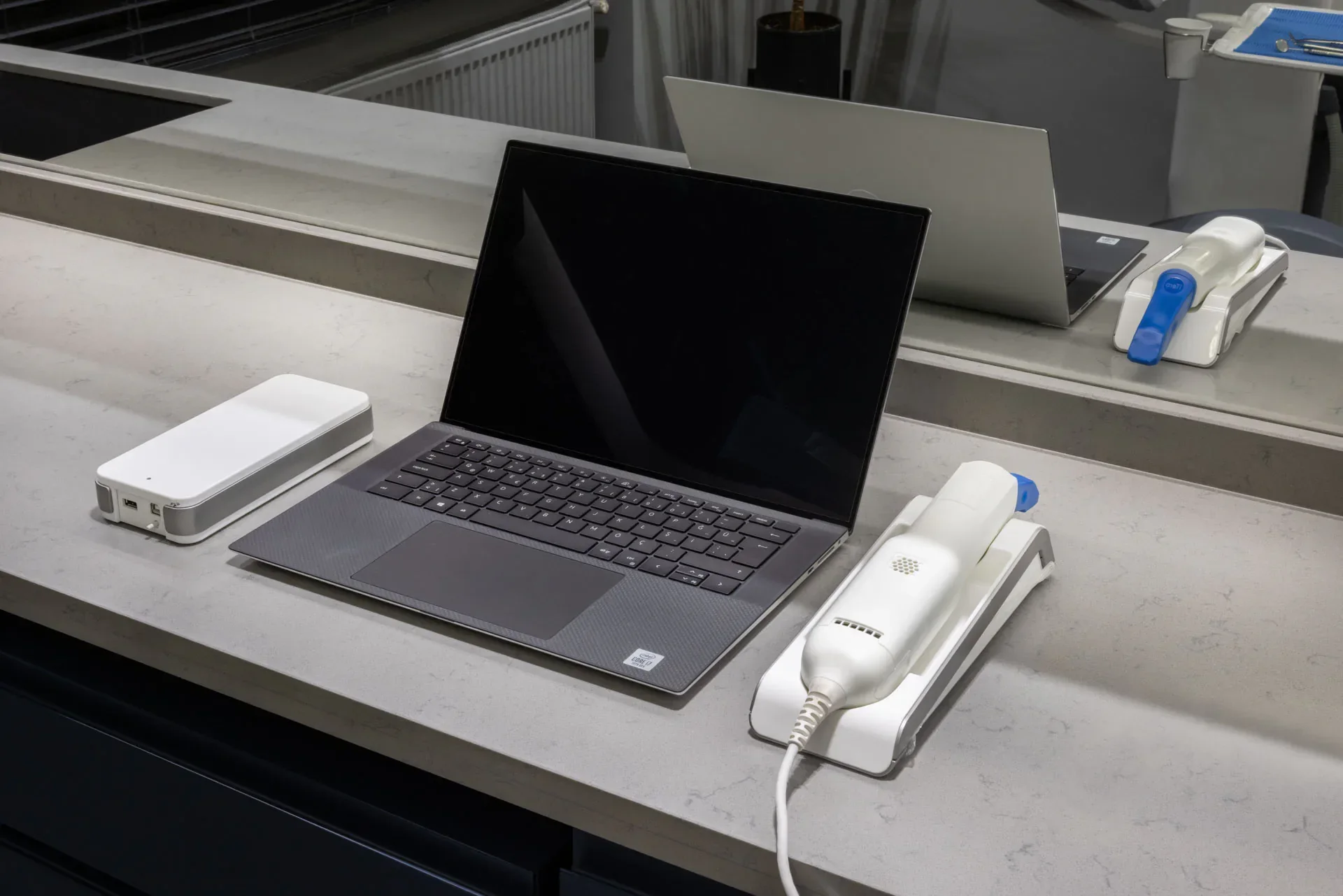
An intraoral scanner records your teeth in 3D without impression putty. Here is how it compares with traditional impressions on comfort, time and accuracy, and where conventional methods are still preferred.

Aesthetics and smile
How Digital Smile Design Works: Process, Mock-Up and Realistic Expectations
Digital smile design is a way of planning treatment, not a treatment in itself. This guide walks through photos, scans and the in-mouth mock-up, and explains what a digital design can and cannot show.
We are happy to answer your questions
You can send your questions on WhatsApp or reach the practice by phone.